ABOUT OCR
Operation Cherry Red (OCR) was launched to elevate the coffee supply chain by focusing on quality, sustainability, and traceability—delivering equal value to producers and roasters. In our pursuit of great coffee, the program initially focused on inspiring farmers to produce high-quality coffee through agronomy and processing protocols, and in result gaining in premium payments. ‘We wanted to spread the message that quality pays‘, said Menno Simons, Founder of Trabocca, when he explained the start of the project.
Now in 2025, we are reviving OCR to spotlight unique Ethiopian smallholder coffees. By working directly with these producers, we ensure premium payments reach the right hands and trace lots back to individual families. For roasters, this is a unique chance to source coffee right at its roots—challenging the norm of sourcing from regional washing stations. By partnering with exceptional smallholders, roasters can support truly impactful, transparent, and traceable coffee supply chains.
The Mission of Operation Cherry Red " Adding value to create an equitable supply chain"
Typically, smallholder coffee producers sell their cherries to local washing stations at prices ranging from 60 to 90 birr per kilogram, earning about 30% of the FOB (Free on Board) price. At these stations, coffees from a network of various regional smallholders are blended together on a daily basis. While traceability protocols are improving heavily, it is often not possible to trace back each lot the exact farmers. Mostly Ethiopian coffees are a produce of regional communities and therefore only labeled by regional indicators. When the Ethiopian Commodity Exchange (ECX) allowed smallholders to obtain their own export licenses a pivotal change occurred.
This shift opened new opportunities for farmers to take greater control over processing, milling, and exporting their coffee. While these added responsibilities demand more effort and expertise, they also bring significant opportunities. Producers who manage their own export operations can retain around 70% of the FOB price—a substantial increase compared to traditional systems.
Our selection for the OCR Smallholder Series in 2025 includes five carefully chosen producers from some of Yirgacheffe’s and Sidamo’s most exciting micro-regions. Typically, smallholders process their coffees as naturals, as this method requires less equipment and is more accessible. However, we’ve also been able to source one washed lot as an alternative. All coffees have been undergoing extensive quality evaluations in our Addis Ababa, Amsterdam, and Minneapolis quality labs, ensuring each lot meets rigorous physical and sensory quality standards. These coffees have impressed us on the cupping table as they exhibit flavor profiles that reflect the unique terroirs of the regions and dedication of the producers.
ABOUT THE FARMER
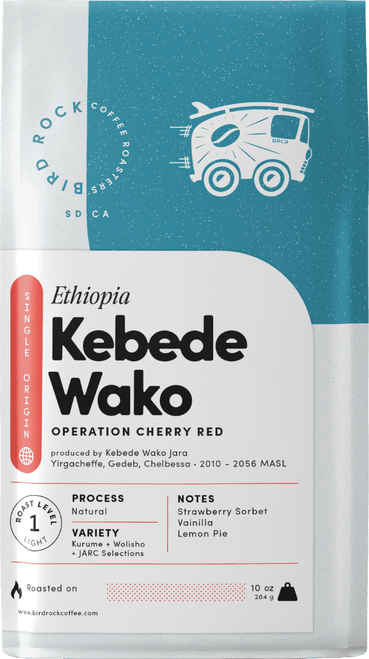
OCR Smallholders series ( Operation Cherry Red) Kebede's farm sits at 2010 – 2056 meters above sea level in one of Yirgacheffe’s most renowned coffee-growing areas. Chelbesa is home to some of the best coffees in the region.
Kebede cultivates a mix of heirloom Ethiopian varieties such as Kurume and Wolisho, alongside JARC selections (74110, 74112). His 16.45-hectare farm is among the largest in the 2025 OCR Smallholder Series, located opposite the Danche Hill, a place famed for producing high-quality coffee.
Kebede Wako runs his coffee farm with the help of his two wives and elder son, Birhanu. His family has been cultivating coffee in Chelbesa, Gedeb, since 2000, making him only the second generation to farm this land. Coffee is the sole source of livelihood for Kebede and his family. In 2018, they obtained their export license to sell directly to international buyers and secure better margins. However, after initially exporting their coffee abroad, they struggled to maintain these relationships, leading them to sell exclusively in the domestic Ethiopian market for the last two years. Now, eager to reconnect with the international market, Kebede is committed to delivering exceptional coffee and building lasting partnerships.
To support their ambitions, the family hires seasonal workers during harvest, ensuring that only ripe cherries are picked. Beyond coffee, Kebede dreams of building a family house in Dilla, a nearby city, to give his children access to better education opportunities. Additionally, they are working towards acquiring a transportation truck to gain greater control and flexibility in moving their coffee to Hawassa for pre-milling.
Kebede and the other participating producers are eager to further improve quality and develop their coffee business.
As daytime temperatures in Gedeb reach 30°C, Kebede wants to invest in shade nets to maintain stable drying conditions, improving quality and consistency. With his renewed focus on international exports, Kebede is determined to showcase the outstanding potential of his coffee.